
Why "the right supplements" can make you feel worse — and how to find your root cause.
Methylation issues aren't just about needing more B vitamins.
They usually come from how your body:
Mutant identifies 7 distinct methylation drivers, so you can stop guessing and start targeting the right system.
Starter uses your 23andMe or AncestryDNA raw DNA file.
WGS goes deeper when broader genomic coverage matters.
Methylation instability is not always solved by adding more B vitamins. The right support path depends on which driver is active: clearance, cofactors, sulfur pressure, structural nutrients, or tolerance-window fragility.
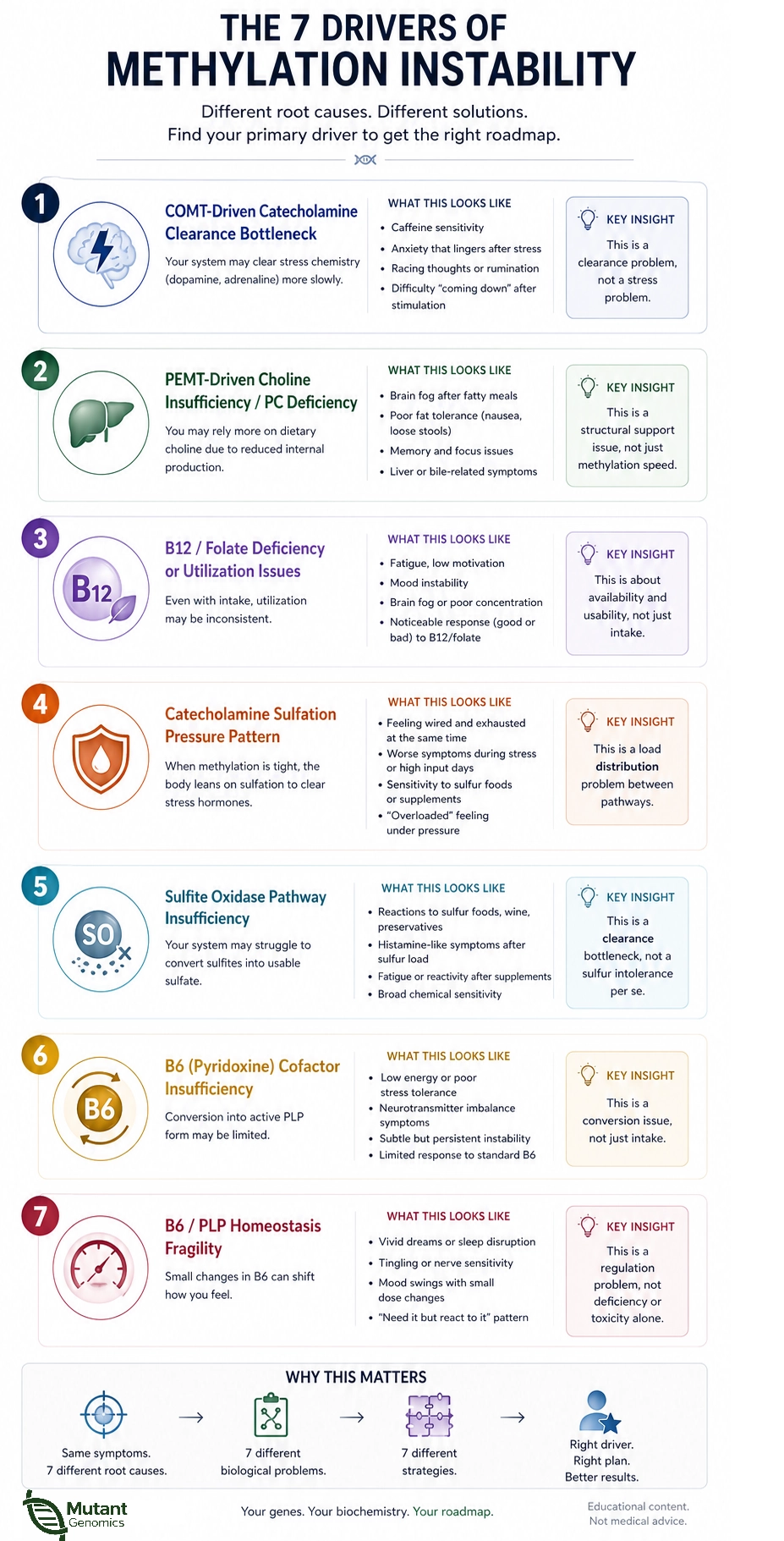
"Stress and stimulation don't shut off easily."
Your system may clear stress chemistry (dopamine, adrenaline) more slowly.
"Fat metabolism and brain clarity are under-supported."
You may rely more on dietary choline due to reduced internal production.
"The system lacks key methyl donors — or can't use them well."
Even with intake, utilization may be inconsistent.
"Backup clearance pathways are under strain."
When methylation is tight, the body leans on sulfation to clear stress hormones.
"Sulfur processing becomes a bottleneck."
Your system may struggle to convert sulfites into usable sulfate.
"You may not activate B6 efficiently."
Conversion into active PLP form may be limited.
"Your system has a narrow tolerance window."
Small changes in B6 can shift how you feel.
People can look very similar on the surface while the biology underneath is not the same. Treating the wrong driver may make things worse, cause a plateau, or produce no change at all.
Methylation instability can come from:
B-complex supplements, methylated vitamins, and generic protocols can help — sometimes a lot. But if the main issue is a clearance bottleneck, sulfur pathway strain, or a narrow tolerance window, the standard approach may only partly help or make things worse.
The goal is not to hand everyone the same methylation protocol. It is to identify which driver looks most active, so the support path matches your actual biology.
Mutant analyzes methylation-related pathways across:
The goal is to identify which methylation driver is most relevant for your picture.
Reduce input and support breakdown rather than pushing more methyl donors.
Focus on improving conversion and availability — not just increasing intake of inactive forms.
Manage load and balance pathways before adding more sulfur-heavy supplements.
Stabilize before pushing. Small changes in either direction may have outsized effects.
Most people in the methylation space try some version of:
Sometimes that helps enough. Sometimes it does not.
When it does not, the next question is usually not "what else should I add?"
It is:
Which methylation driver am I actually dealing with?
That is what Mutant is built to help you answer.
Upload your DNA or start with your symptoms to identify your primary methylation driver, understand your tolerance window, and get a roadmap tailored to your biology.
Your genes. Your biochemistry. Your roadmap.
Starter works with 23andMe or AncestryDNA.
WGS goes deeper when broader coverage matters more.
Methylation instability can involve clearance bottlenecks, sulfur pathway strain, cofactor conversion issues, or narrow tolerance windows. In those cases, more methyl donors may not match the active driver.
Starter analysis uses 23andMe or AncestryDNA raw DNA files. WGS analysis uses whole genome sequencing for broader coverage and fewer blind spots.
The goal is to identify which methylation driver looks most active, so the support path matches the biology instead of relying on a generic B-vitamin protocol.
Mutant provides educational, informational analysis and is not a substitute for medical advice, diagnosis, or treatment.