
Why histamine reactions happen, why the standard low-histamine approach often plateaus, and how to find the driver that best fits your biology.
Histamine problems are not just about high-histamine foods.
They often reflect a mix of clearance, release, gut production, timing, and neuroimmune reactivity. That is why two people can both say they have "histamine intolerance" while needing very different next steps.
Mutant helps sort that picture into the driver that may be most relevant for you now.
Starter uses your 23andMe or AncestryDNA raw DNA file.
WGS goes deeper when broader genomic coverage matters.
Histamine reactions are not only about high-histamine foods. The right next step depends on whether the active driver is clearance, release, gut spillover, timing, or neuroimmune reactivity.
Histamine sensitivity is often driven by interacting clearance, release, gut, timing, and neuroimmune pathways rather than food alone.
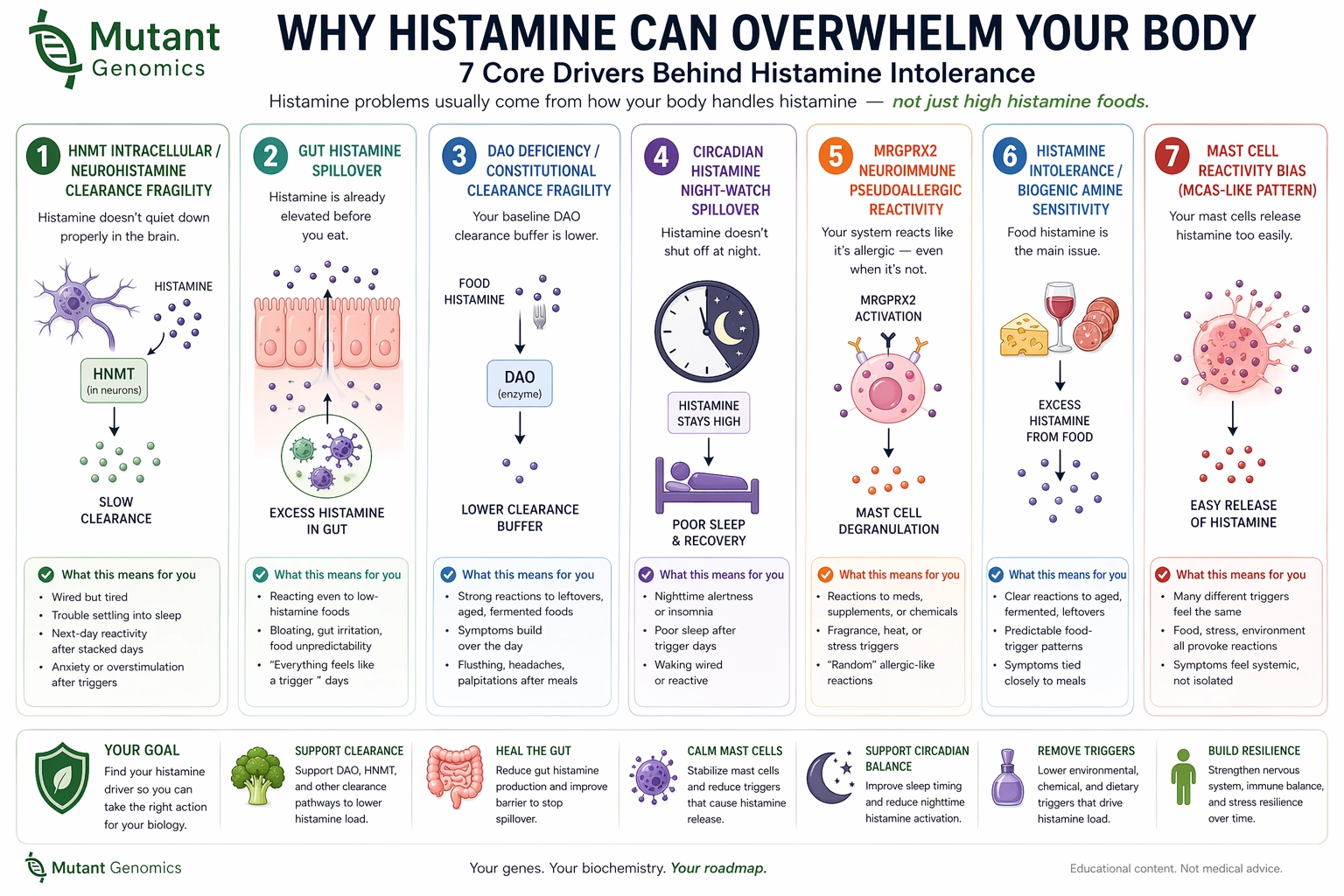
"Histamine does not quiet down properly in the brain."
Your intracellular histamine clearance may run slower, especially at night.
"Histamine is already elevated before you eat."
Your gut may be producing, recycling, or holding onto histamine.
"Your baseline histamine buffer is lower."
DAO is one of the main enzymes involved in clearing histamine from food.
"Histamine does not shut off at night."
Histamine helps regulate wakefulness. If the signal stays elevated, sleep suffers.
"Your system reacts like it is allergic, even when it is not."
A non-IgE mast-cell pathway can trigger sudden reactions to things that do not fit the usual food-intolerance story.
"Food histamine is the main issue."
Your body struggles to break down histamine from what you eat.
"Your mast cells release histamine too easily."
Your system is more reactive to triggers in general.
People can look very similar on the surface while the biology underneath is not the same.
Histamine problems can come from:
A low-histamine diet, DAO supplements, freshness rules, and antihistamines can help - sometimes a lot. But if the main issue is gut spillover, mast-cell release, nighttime histamine signaling, or neuroimmune reactivity, the standard approach may only partly help.
The goal is not to hand everyone the same histamine protocol. It is to identify which histamine lane looks most active, so the support path matches the driver.
Mutant analyzes histamine-related pathways across:
The goal is to show which histamine driver may be most relevant for your picture.
Starter uses 23andMe or AncestryDNA microarray data. It can still be very useful, but it gives a partial genomic view.
That matters in histamine because some parts of the picture may come through more clearly than others. Food-histamine pathways may be easier to see than narrower or deeper overlaps involving methylation, sulfur, transport, clearance, or layered neuroimmune biology.
So Starter is best thought of as:
But not always the fullest histamine picture.
WGS is the better fit when you want broader genomic visibility and fewer blind spots.
Focus more on clearance and meal-linked exposure.
Look harder at gut instability, fermentation, barrier stress, and histamine load that starts before the meal.
The problem may be trigger sensitivity and system-wide reactivity more than food histamine alone.
Sleep timing, nighttime load, and "histamine that does not shut off" may matter more than another elimination list.
The picture may involve broader threshold fragility, supplement or chemical sensitivity, and system-wide signaling rather than classic food intolerance alone.
Most people in the histamine community try some version of:
Sometimes that helps enough. Sometimes it does not.
When it does not, the next question is usually not "what else should I remove?"
It is:
Which histamine driver am I actually dealing with?
That is what Mutant is built to help you answer.
Use your DNA to identify which histamine pathway may be most relevant, see how your biology behaves under load, and explore the support direction that best matches the picture.
Starter works with 23andMe or AncestryDNA.
WGS goes deeper when broader coverage matters more.
Because food histamine is only one source. Histamine reactions can also come from slower clearance, gut production, mast-cell release, circadian timing, or neuroimmune reactivity.
Starter analysis uses 23andMe or AncestryDNA raw DNA files. WGS analysis uses whole genome sequencing for broader coverage and fewer blind spots.
The goal is to identify which histamine driver looks most active, so the support path matches the biology instead of applying the same low-histamine strategy to everyone.
Mutant provides educational, informational analysis and is not a substitute for medical advice, diagnosis, or treatment.