
Upload your raw 23andMe, AncestryDNA, or WGS file to map your likely oxalate drivers for free.
Oxalate sensitivity is not always solved by eating fewer high-oxalate foods.
For many high-sensitivity users, a low-oxalate diet can be a useful safety tool. But when symptoms persist despite careful restriction, the next question is not always:
Which food do I remove next?
The better question is:
Why is my oxalate threshold so narrow in the first place?
Mutant helps you move from generic oxalate restriction to driver-matched pattern analysis.
If you react to high-oxalate foods, minerals, sulfur supplements, vitamin C, B6 changes, gut flares, constipation, fat digestion problems, or "dumping-like" episodes, the next step is not always more restriction.
The better question is:
Which oxalate driver is actually active?
Mutant uses your raw DNA file to help map oxalate-related pathways across sulfur handling, endogenous oxalate production, intestinal oxalate export, gut absorption, mineral binding, B6/PLP regulation, gut barrier stress, and related histamine or thyroid overlap.
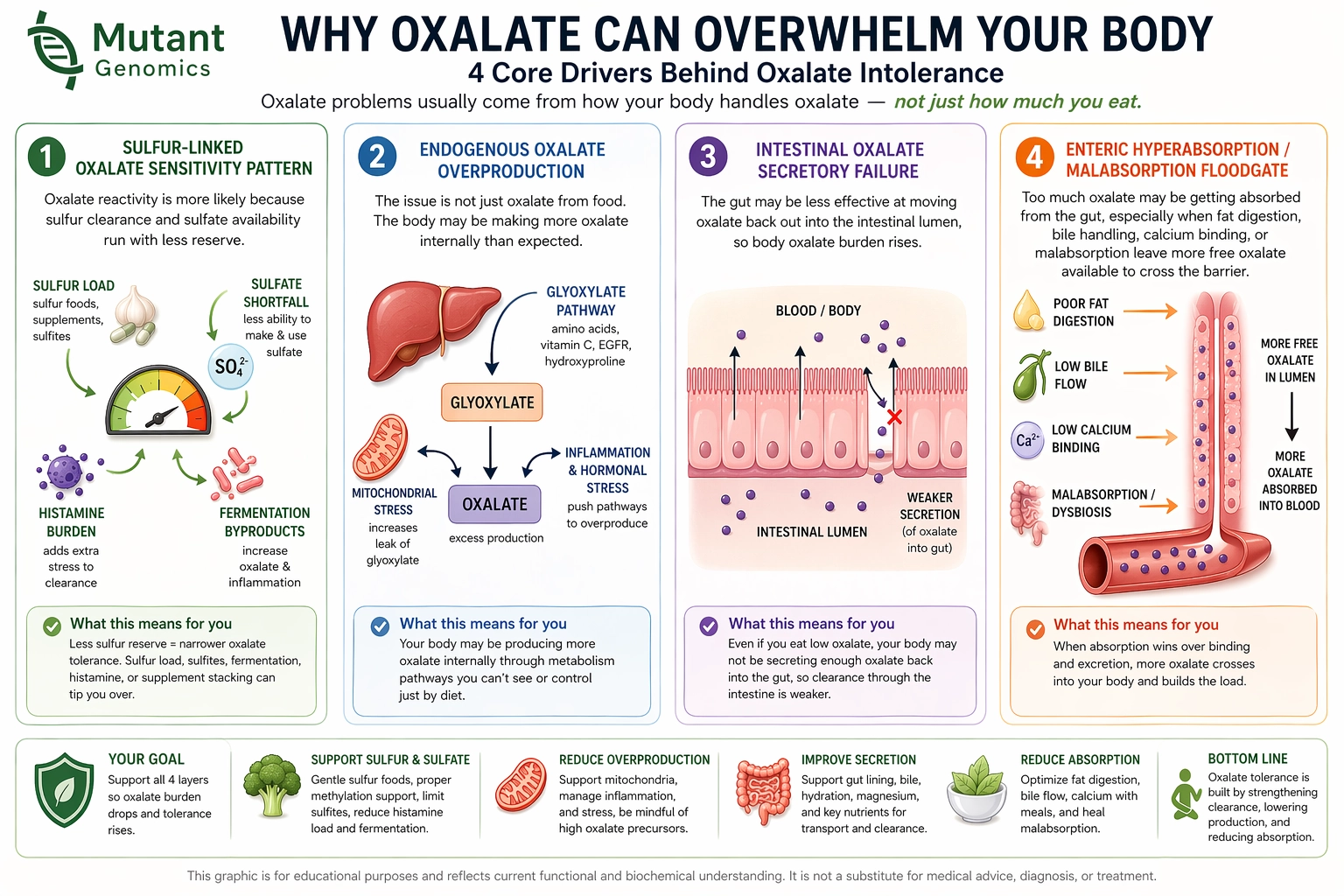
Mutant does not treat oxalate sensitivity as one single diet problem.
It separates your pattern into four possible driver lanes:
Each lane points to a different interpretation.
That matters because two people can both say they have "oxalate issues" while needing very different strategies.
One person may need better meal binding. Another may need to reduce sulfur pressure. Another may need to look at B6/PLP adequacy. Another may need to stabilize stool rhythm, motility, gut barrier stress, fat digestion, or thyroid-linked digestive slowdown.
"Oxalate tolerance narrows when sulfur pressure rises."
Some users notice oxalate symptoms become louder when sulfur load, sulfite pressure, or sulfur-handling bottlenecks are active.
This can happen during periods of high sulfur foods, sulfur supplements, aggressive detox stacks, sulfite exposure, glutathione support, NAC, MSM, alpha-lipoic acid, or broader chemical-load stress.
"The body may be producing more oxalate internally."
Some oxalate burden may come from internal production rather than food intake alone.
This lane may fit when symptoms seem disproportionate to dietary oxalate exposure, especially after obvious enteric, vitamin C, hydration, and kidney-stone risk confounders are separated.
"The gut may not export oxalate efficiently."
This lane is different from absorbing too much oxalate from food.
In this pattern, oxalate burden may rise because the intestine is less able to move oxalate from the body back into the gut for elimination.
That makes gut stability, stool rhythm, mucus surface integrity, hydration, epithelial stress, and motility especially important.
"The gut may be absorbing too much oxalate."
In this lane, oxalate burden may rise because the gut absorbs too much oxalate under malabsorption conditions.
This can happen when fat malabsorption, bile-acid disruption, poor calcium binding, gut inflammation, or meal timing leaves more free oxalate available for absorption.
Most people in the oxalate community try some version of:
Sometimes that helps.
Sometimes it does not.
When it does not, the next question is usually not:
What else should I remove?
It is:
Which oxalate driver am I actually dealing with?
A low-oxalate diet may reduce exposure, but it does not tell you whether the main problem is sulfur-linked sensitivity, internal oxalate production, gut export failure, malabsorption-driven hyperabsorption, thyroid-linked motility issues, methylation/B6 strain, or histamine-like gut immune reactivity.
That is the gap Mutant is built to fill.
This roadmap is about driver matching and protocol direction.
It is not:
The goal is not to chase every oxalate theory.
The goal is to identify which lane is actually worth supporting.
Mutant analyzes oxalate-related pathways across:
The goal is not to tell every user to follow a stricter food list.
The goal is to show which oxalate driver may be most relevant for your biology.
Mutant is currently offering free genetic pattern scans as part of our early product buildout.
The goal is simple:
We are being upfront about that.
The free scan is the starting point. The long-term product is a contextual AI companion that helps you understand what your patterns may mean over time.
Your raw DNA file is not the product. The product is the interpretation layer we are building.
Mutant supports two levels of DNA input.
Consumer DNA file analysis uses microarray data from 23andMe or AncestryDNA.
This can be useful as a first-pass map for common oxalate-related patterns, especially when the goal is to identify likely driver direction.
A consumer DNA file can help answer questions such as:
WGS goes deeper.
It can provide broader coverage and fewer blind spots, especially when the pattern may involve less common variants, layered metabolic pathways, transport biology, gut immune overlap, or multiple biological hubs.
WGS is the better fit when:
Every Mutant oxalate protocol starts with the same foundation:
This matters because oxalate patterns are easy to misread when the system is already overloaded.
If the user is underfed, over-supplemented, highly stressed, reacting to environmental triggers, changing too many variables, constipated, dehydrated, or unstable from poor sleep, the oxalate signal becomes harder to interpret.
The foundation is not optional background.
It is what makes the protocol readable.
Mutant does not frame oxalate recovery as "just reintroduce oxalates."
Some users may eventually broaden their diet, but that is not the protocol itself.
The protocol does not ask the user to challenge high-oxalate foods to prove recovery.
It focuses on:
Food expansion, if it ever happens, is downstream of stability - not the starting goal.
Oxalobacter formigenes is often discussed in the oxalate community, but Mutant's current oxalate protocols do not attempt to restore Oxalobacter or make it the central mechanism.
The Mutant roadmap focuses on mechanisms that can be more directly mapped into protocol decisions:
Oxalobacter may be biologically relevant in some contexts, but it is not the operational center of these protocols.
Do not push sulfur harder.
The strategy is usually to reduce noisy inputs, avoid sulfur overshoot, consider sulfur-handling cofactors carefully, and recheck whether the oxalate lane becomes quieter.
Read the free methylation DNA analysis if sulfur reactions overlap with methyl donors, B vitamins, COMT-like stimulation, or detox sensitivity.
Do not assume the answer is only more food restriction.
The strategy is usually to review vitamin C exposure, protect hydration and binding, consider a low B6 adequacy floor, and use objective urine testing when appropriate.
Read the free methylation DNA analysis if this overlaps with B6/PLP sensitivity, sulfur handling, or methylation instability.
Do not force dumping.
The strategy is usually to stabilize stool rhythm, hydration, motility, epithelial resilience, and gut inflammation before making strong conclusions about oxalate clearance.
Read the free thyroid DNA analysis if this overlaps with constipation, low energy, slow transit, or low T3/T4 patterns.
Do not treat it as a generic "take calcium" problem.
The strategy is usually meal-timed binding, fat-digestion review, bile-flow clues, stool-form tracking, and objective testing when appropriate.
Read the free thyroid DNA analysis if this overlaps with poor fat tolerance, constipation, low energy, or sluggish digestion.
Do not assume every flare is oxalate dumping.
Gut irritation, mast-cell reactivity, food histamine, and inflammatory signaling can make oxalate symptoms feel allergic or MCAS-like.
Read the free histamine DNA analysis if oxalate symptoms overlap with flushing, itching, insomnia, anxiety-like activation, food reactions, or broad trigger sensitivity.
Low-oxalate restriction can be useful as a temporary sanctuary.
It can lower exposure, reduce acute load, and help create a quieter baseline.
But restriction alone does not tell you which biological driver is narrowing your threshold.
Mutant's approach is different:
The goal is not permanent restriction.
The goal is driver-matched stability.
Success does not have to mean eating high-oxalate foods.
Early success may look like:
A protocol is working when the system becomes more readable.
Stop self-directed protocol experimentation and seek formal evaluation when there are red flags such as:
Mutant is designed to help organize patterns, not replace evaluation for serious kidney, metabolic, or gastrointestinal conditions.
If you have been restricting oxalates for years and still feel reactive, the next step may not be another smaller food list.
It may be a clearer map.
The real question is:
Which oxalate driver is most active in my biology?
Mutant helps organize your raw DNA data into a clearer oxalate driver map so you can stop treating every oxalate symptom as the same problem.
Yes. Mutant consumer DNA file analysis is designed to work with consumer raw DNA files such as 23andMe and AncestryDNA.
It can help map common oxalate-related patterns, including sulfur-linked sensitivity, endogenous oxalate production, B6/PLP handling, gut export biology, and enteric hyperabsorption clues.
Yes. AncestryDNA raw data can be used for consumer DNA file analysis.
Coverage is still limited compared with WGS, but it can provide a useful first-pass view of oxalate-related driver patterns.
WGS usually provides broader genomic coverage and fewer blind spots.
That matters when oxalate symptoms overlap with sulfur, methylation, B6/PLP, gut transport, thyroid, histamine, mast-cell reactivity, or malabsorption pathways.
Because dietary oxalate is only one possible input.
A strict diet may lower external load, but it may not address sulfur-linked sensitivity, endogenous production, intestinal export failure, enteric hyperabsorption from malabsorption, thyroid-linked motility problems, or histamine-like gut immune reactivity.
Not primarily.
The protocols are designed to avoid forced dumping and overshoot.
The goal is not to trigger a purge. The goal is to stabilize the lane so your body's response becomes more predictable and the next step is easier to judge.
If a protocol makes symptoms more chaotic, that is not automatically progress.
A Calcium Anchor is the strategic use of calcium with an oxalate-containing meal to bind oxalate in the gut lumen before it is absorbed.
The key is timing.
Calcium taken away from food does not bind the oxalate in that meal.
This matters most in enteric hyperabsorption / malabsorption patterns.
B6, in its active PLP-related role, supports glyoxylate handling.
In the endogenous overproduction lane, the goal is not megadosing. The protocol uses the concept of a low B6 adequacy floor and watches for response over time.
High-dose B6 belongs in a qualified hyperoxaluria evaluation context, not as a casual self-experiment.
Methylation overlaps with oxalate biology through B6/PLP handling, sulfur metabolism, transsulfuration, stress chemistry, and detox pressure.
If oxalate symptoms overlap with methyl donors, sulfur reactions, B-vitamin sensitivity, or COMT-like stimulation, read the free methylation DNA analysis.
Oxalate-related gut irritation can amplify mast-cell and histamine-like symptoms.
If oxalate symptoms overlap with flushing, itching, insomnia, anxiety-like activation, food reactions, or broad trigger sensitivity, read the free histamine DNA analysis.
Thyroid signaling can influence gut motility, bile flow, fat digestion, metabolic pace, and stool rhythm.
If oxalate symptoms overlap with constipation, poor fat tolerance, low energy, cold intolerance, low T3/T4 patterns, or sluggish digestion, read the free thyroid DNA analysis.
No.
Mutant provides educational analysis and protocol direction. It does not diagnose, treat, or cure disease.
The goal is to make the oxalate problem more organized: which driver fits, which supports are logical, which steps are risky, and when objective testing or medical evaluation matters.
During the current founder-access period, Mutant is offering free genetic pattern scans to help users explore their biology and to help improve the platform.
Mutant is currently free during early access while we expand system coverage, improve the analysis, and build a track record using real-world feedback. Access and pricing may change in the future, but any future options will be explained clearly before users choose them.
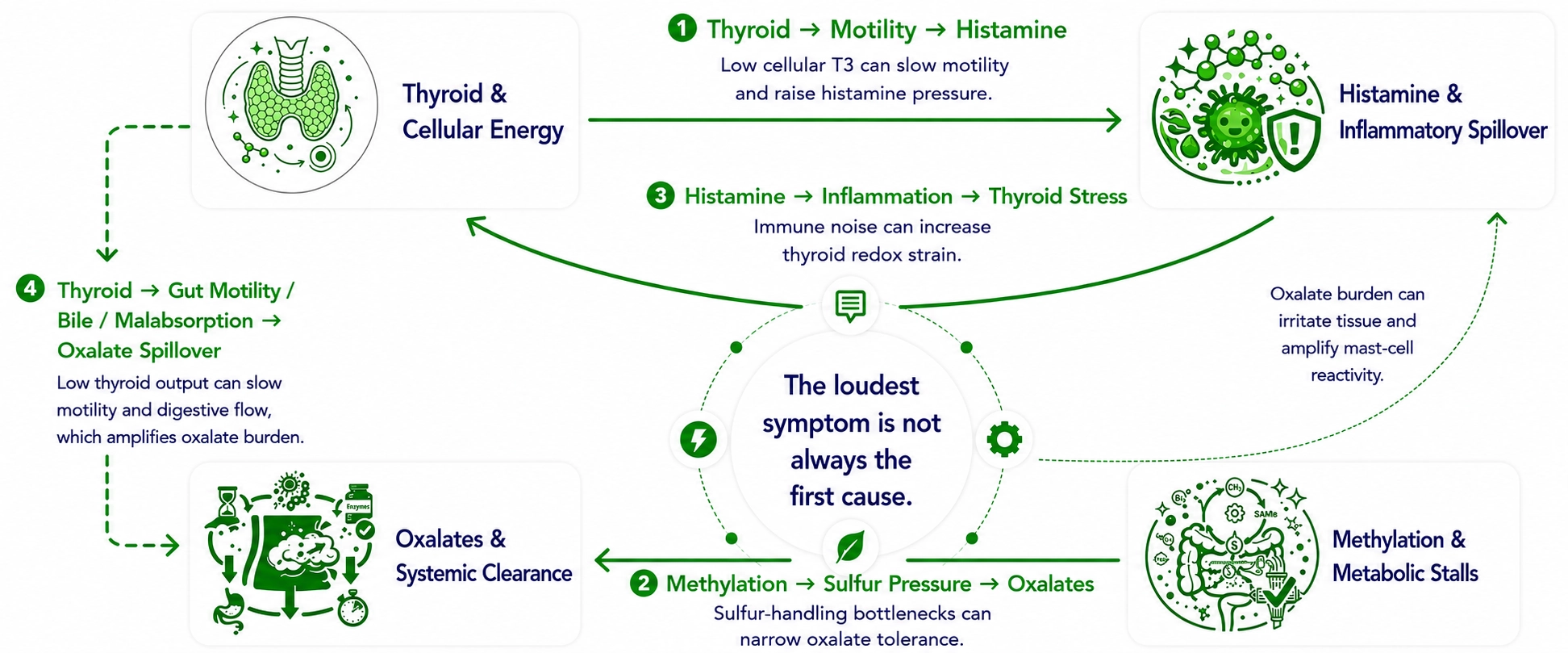
Oxalate sensitivity rarely exists in isolation. These roadmap pages connect the most common overlapping biological hubs.
The four metabolic reactivity hubs — Oxalates, Histamine, Thyroid, and Methylation — do not operate alone. Mutant maps the chain reactions between them:
Mutant provides educational, informational genetic pattern analysis. It does not diagnose, treat, cure, or prevent disease and is not a substitute for medical advice, diagnosis, or treatment.