Thyroid / Histamine
When Thyroid Is Indirect: How a Cellular T3 Bottleneck Can Become a Histamine and Digestion Problem
Many people are not born with a direct gut defect or a simple histamine problem. Instead, subtle weaknesses in thyroid hormone activation, cellular energy, motility rhythm, bile flow, and histamine clearance can gradually converge over time.
That is why the problem visible at age 40 or 50 is not always where the story started. Histamine intolerance may look like a food problem, bloating may look like a microbiome problem, and constipation may look like a fiber problem.
Is the gut moving, clearing, repairing, and digesting at the metabolic pace it was designed for?
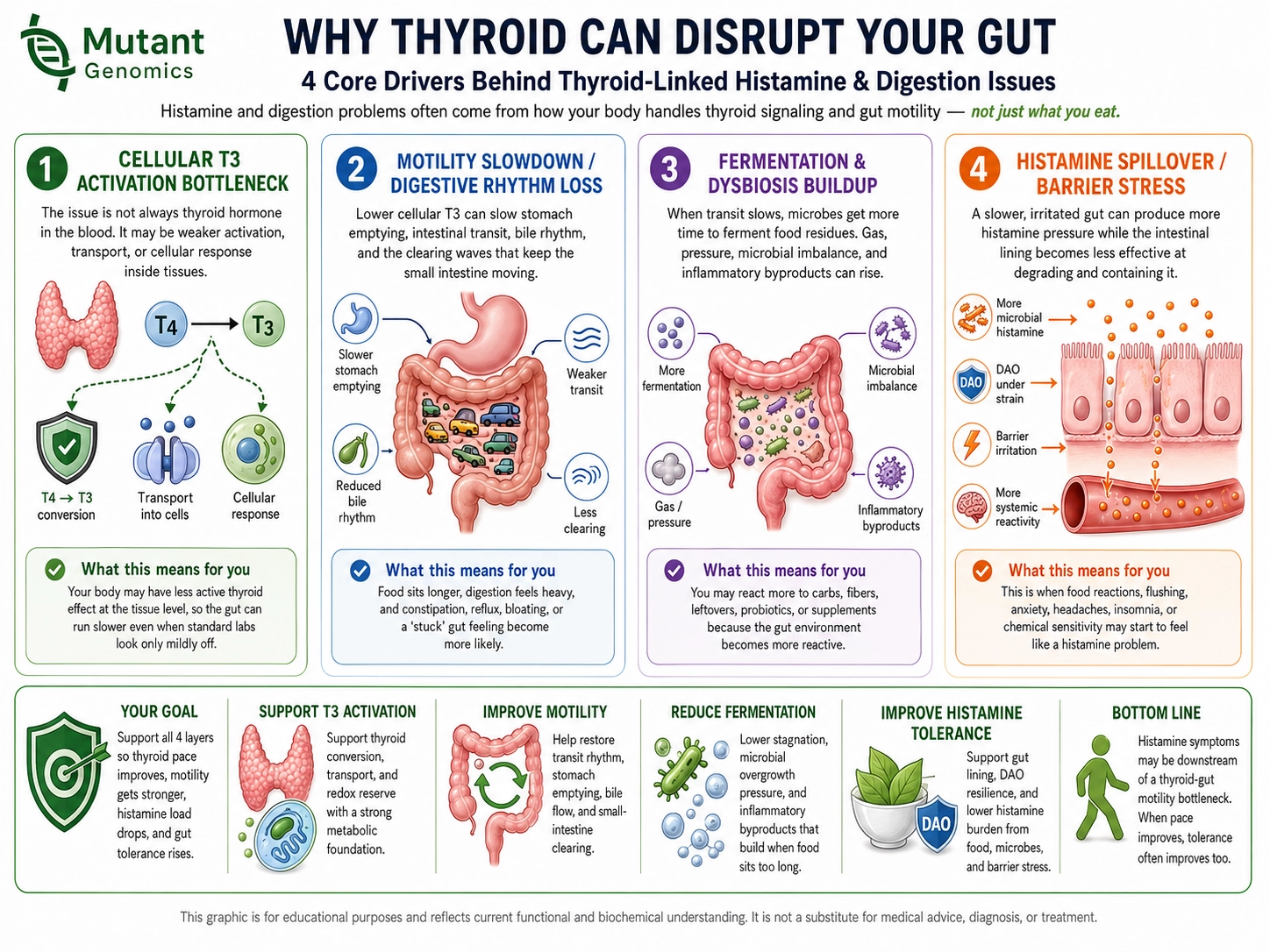
When cellular T3 effect is low, the digestive system can lose rhythm. Food moves more slowly, fermentation increases, the gut barrier becomes noisier, and histamine-producing bacteria can matter more over time.
Quick Answer
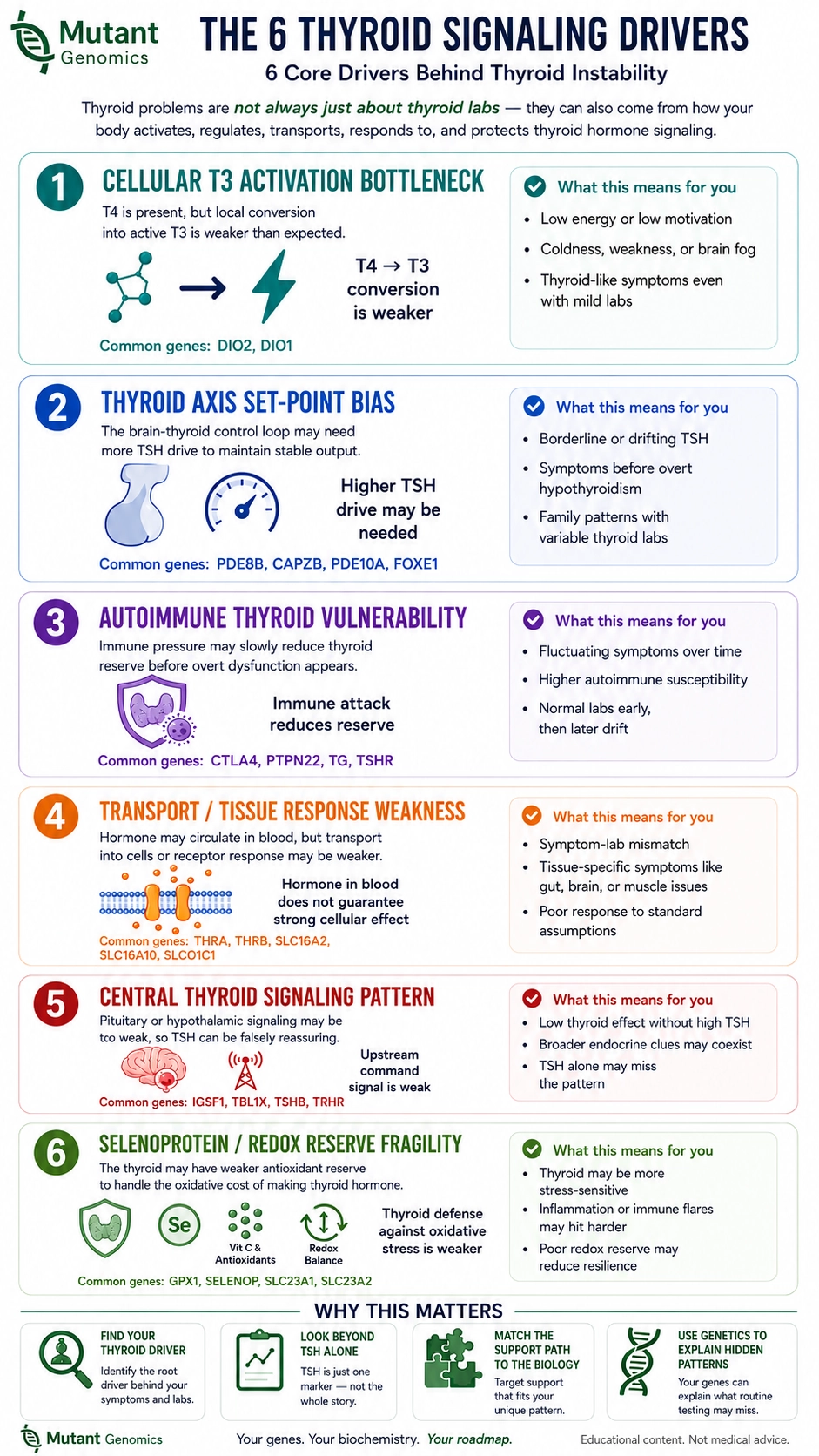
Cellular T3 activation is one of the most important upstream knobs for gut rhythm. T4 is the storage hormone, T3 is the active signal, and the body still has to convert, transport, and respond to that signal inside tissues.
When local T3 effect is inefficient, the gut may slow down even when standard thyroid labs do not look dramatic. This can affect stomach emptying, intestinal transit, bile rhythm, enzyme timing, microbial balance, gut barrier repair, and histamine clearance pressure.
The result is often an indirect histamine pattern where thyroid is not the only driver, but it may be the upstream pace-setter that made the histamine system harder to stabilize.
- "I react to leftovers."
- "I cannot tolerate fermented foods."
- "I bloat from normal carbs."
- "I get anxiety, insomnia, flushing, or headaches from foods."
- "My gut feels stuck."
- "My histamine symptoms improve when motility improves."
The Core Idea: T3 Is a Cellular Signal, Not Just a Lab Value
The thyroid story is often oversimplified. Many people think low thyroid always means high TSH, normal TSH means thyroid is fine, histamine symptoms mean mast cells or histamine genes, and bloating means gut bacteria. But the body is not organized that way.
Thyroid hormone has to move through a chain:
- The thyroid produces mostly T4.
- T4 has to be converted into active T3.
- T3 has to enter cells.
- Cells have to respond to the signal.
- Mitochondria, nerves, smooth muscle, bile flow, and repair systems have to execute the program.
A bottleneck anywhere in that chain can create a lower-thyroid-effect state at the tissue level. That is the logic behind the Cellular T3 Activation Bottleneck.
This pattern is not saying every person has classic hypothyroidism. It is saying some people may have weaker local activation, transport, or cellular response. In the gut, that can show up as sluggish rhythm long before it looks like a clean textbook thyroid diagnosis.
Why This Is Not Just a Histamine Gene Problem
Histamine genes still matter. DAO, HNMT, MAO-A, methylation, gut barrier, and mast-cell-related pathways can all shape how a person handles histamine. But genes often act through systems.
A person with mild histamine weakness may do well for decades if motility, bile flow, microbiome balance, and thyroid pace are strong. Another person with similar histamine genetics may become highly reactive if cellular T3 effect is low, transit slows, digestion weakens, and microbial histamine load rises.
Is histamine the root driver, or is histamine the alarm bell from a slower thyroid-gut system?